

Can AI-designed proteins speed up the search for new antibiotics?
Introduction
Antibiotic discovery faces a numbers problem. Drug-resistant infections are widening the gap between the bacteria existing medicines can treat and the supply of new drugs. Finding a promising candidate remains slow, requiring screening, testing and refinement.
AI protein design could broaden the search. Rather than looking only at molecules found in nature, researchers can use computational biology to propose new protein and peptide sequences, then test whether they stop bacterial growth. The aim is not an instant cure, but a faster way to find candidates worth studying in the lab. In this way, AI protein design can expand the range of molecules researchers consider.
A plausible sequence on a computer is not proof that a molecule will work in an infected body, avoid harming human cells or be practical to manufacture as a medicine. AI may speed up the early stages of antibiotic discovery, but the challenges that follow remain. AI protein design is one part of that process, not a shortcut past biological testing.
Analysis of the teams: the model, the molecule and the microbe
AI protein design is best seen as a research tool, not a replacement for scientists. Generative models can propose sequences with specific features, while other tools predict how a protein may fold or interact with a target. These predictions help researchers decide which candidates to synthesise instead of testing every possible sequence. For computational biology teams, AI protein design offers a way to prioritise experiments.
One promising class for antimicrobial research is short peptides: chains of amino acids that can disrupt bacterial membranes or interfere with essential processes. Some naturally occurring antimicrobial peptides help protect humans and other organisms from infection. Designing new versions could let scientists explore shapes and chemical properties that evolution has not already produced. AI protein design may help explore this chemical space, though proposed peptides still need to be made and tested.
Bacteria are not passive targets. They vary, adapt and exchange genetic material, so a compound that works against one strain may fail against another. Some bacteria can change their membranes, pump compounds out of their cells or protect the machinery a drug targets. Candidates must therefore be tested against a range of organisms, including drug-resistant bacteria. AI protein design can suggest candidates, but it cannot predict every bacterial response with certainty.
A designed molecule is not automatically a usable antibiotic. Peptides can break down in the body, struggle to reach an infection site or become toxic at doses high enough to work. Many are difficult or expensive to manufacture at scale, and some cannot be taken as a pill. Design can produce a promising starting point; medicinal chemistry, formulation and clinical research determine whether it can become a treatment. These practical constraints should inform AI protein design from the outset.
Key factors
The first factor is the quality of the training data. Models learn from existing sequences and experiments, but the available records are uneven: some bacterial species and types of activity have been studied far more than others. With narrow or biased data, a model may reproduce familiar patterns rather than identify a genuinely useful new approach. Better data can make AI protein design more informative, but cannot remove the need for experimental evidence.
The second factor is what researchers ask the model to optimise. A sequence that scores well for predicted antibacterial activity may perform poorly in terms of toxicity, stability or selectivity. The goal is not simply to kill bacteria in a dish. A useful molecule must harm the pathogen while sparing human cells and remain active under realistic biological conditions.
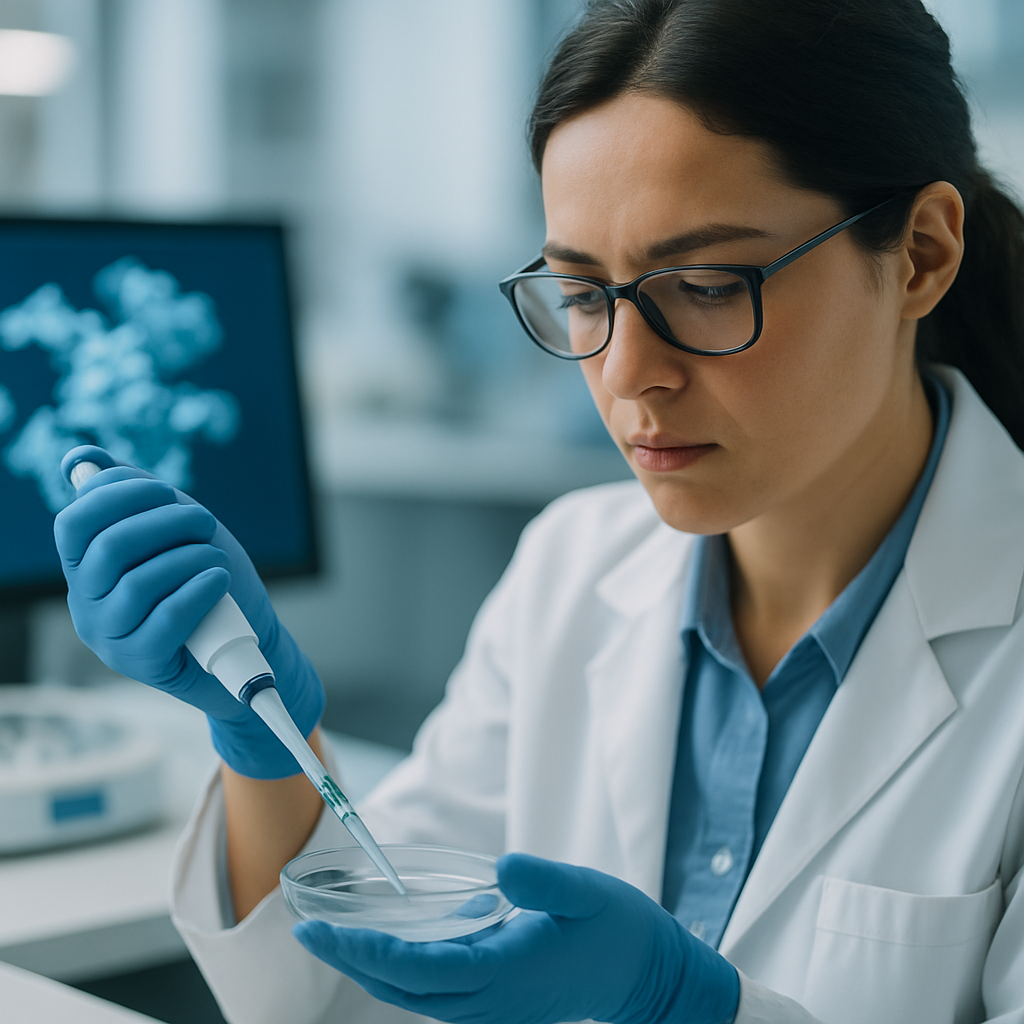
Laboratory testing is the decisive checkpoint. This laboratory validation requires scientists to synthesise proposed candidates, test them against bacteria, compare their activity with existing antibiotics and assess their toxicity and stability. Further studies can show how a candidate works, whether resistance emerges quickly and whether it remains effective in animal models. A successful prediction is a lead, not proof of a medicine.
The feedback loop matters as much as the algorithm. By feeding lab results back into a model, researchers can refine later designs and avoid repeatedly testing unproductive sequences. This works only when experiments are reliable and results are reported in a comparable form. Faster predictions help; faster, trustworthy learning helps more.
The broader challenge is antimicrobial resistance. A new drug that targets bacteria in the same way as existing treatments may still be valuable, but bacteria may already have ways to evade it. Candidates with distinct mechanisms could be especially useful, though experiments are needed to confirm that distinction. AI may be most helpful in exploring a wider range of possibilities, including ones human designers might overlook.
Faster discovery does not necessarily mean faster delivery. Promising compounds must pass safety and efficacy tests, address manufacturing challenges and undergo clinical trials. Antibiotic development also faces commercial obstacles: medicines meant to be used sparingly may not generate the same sales as treatments taken continuously. AI can reduce some scientific uncertainty, but it cannot change the incentives that affect which drugs reach patients.
Match scenario: from sequence to medicine
The most realistic path is a series of steps, not a sudden breakthrough. A model generates many candidate peptides; filters narrow the options using predicted structures and properties; researchers synthesise a manageable number; and lab tests identify those worth studying further. At each stage, fewer candidates move forward, supported by more evidence. AI protein design contributes to the early choices in this sequence of steps.
AI protein design could save time by cutting down on failed attempts and identifying candidates that conventional screening might miss. It could also help tailor molecules to specific bacterial targets. But predictions can be misleading: a sequence that looks promising in a model may fail in a dish, while one with a modest score may show useful activity when tested.
Progress should be measured not by the number of sequences generated or the speed of a software run, but by whether teams can repeatedly turn predictions into compounds that work against relevant pathogens, remain safe and can be developed into treatments. Without that evidence, the apparent advantage is only an early result.
Conclusion
AI protein design can speed up parts of antibiotic discovery by giving researchers more molecules to consider and helping them choose which ones to test. That is a meaningful advantage in a field facing antimicrobial resistance, but it does not bypass the realities of biology.
Designed candidates still have to meet the challenges of infection: bacterial diversity, resistance, toxicity, delivery and development. With strong laboratory testing and careful follow-up, AI models may help researchers find better leads sooner. The promise is acceleration, not automation; any antibiotic that matters will still have to prove itself beyond the screen.